A jewelry maker comparing 304L and 316L stainless steel raised a reasonable question: if 316L can contain more nickel, why is it so often chosen for jewelry that sits against the skin?
The short answer is that bulk nickel content and nickel release are different measurements. The steel grade matters, but corrosion resistance, surface condition, manufacturing process and the finished product test matter too.
Yes, 316L can contain more nickel than 304L
Composition varies within each grade specification, so one number should never be treated as the only possible result. As one published producer example, Outokumpu lists a typical 304L grade at 8.1% nickel, while its typical 316L grade contains 10.1% nickel and 2.1% molybdenum.
That means a buyer should not describe 316L as a nickel-free material. The reason it is frequently selected is not that it contains no nickel; it is that the alloy is designed to resist corrosion more effectively in many demanding environments.
Why molybdenum changes the practical choice
The molybdenum addition in 316L improves resistance to localized corrosion, particularly in chloride-containing environments. For jewelry, that matters because skin contact can involve perspiration, humidity and salt.
Better corrosion resistance helps the steel maintain its protective passive surface. It does not prove that every finished item will meet a nickel-release limit, but it is one reason 316L is commonly preferred over 304L for many skin-contact products.
Why the medical comparison needs a qualification
The phrase “medical-grade 316L” is often used too loosely. Ordinary commercial 316L and implant stainless steel are not automatically interchangeable.
The FDA-recognized ISO 5832-1 surgical implant standard describes wrought stainless steel corresponding to UNS S31673, which is also referenced by ASTM F138 and ASTM F139. A generic 316L material certificate alone does not establish that an item is implant grade.
What nickel release means for jewelry
Nickel content describes how much nickel is present in the alloy. Nickel release measures how much nickel migrates from the finished surface under defined test conditions. A material can contain nickel and still release a much smaller amount because the surface remains passive and corrosion resistant.
For the European market, REACH Annex XVII Entry 27 sets a migration limit of less than 0.2 μg/cm²/week for posts inserted into pierced ears or other pierced parts of the body. For articles intended for direct and prolonged skin contact, the release rate must not exceed 0.5 μg/cm²/week. Coated items must continue to meet the applicable limit for at least two years of normal use.
These are regulatory performance limits, not a statement that every wearer will react in the same way. People with high sensitivity may still experience a reaction to products that other wearers tolerate.
How a brand should verify the claim
- Verify the steel grade. Ask for a material certificate or composition test when the grade is commercially important.
- Define the target market. The applicable release limit and test method depend on where the product will be sold and how it contacts the body.
- Test the finished product. Request nickel-release testing on a finished, production-representative item rather than relying only on the raw material report.
- Include every relevant component. Posts, clasps, chains, pendants and findings may come from different production routes and should not be assumed to perform identically.
- Consider coating wear. If a coating is part of the compliance strategy, confirm the conditioning and durability requirements with the laboratory before testing.
A supplier may be able to coordinate third-party laboratory testing, but the testing fee is normally paid by the buyer. The report should identify the product, tested components, method, result and laboratory.
Documented test result
Nickel-release test example for a gold-tone chain component
A gold-tone metal main-chain component from a sample submitted by Jinming was evaluated by a third-party laboratory using BS EN 1811:2023 and EN 12472:2020, with ICP-OES analysis.
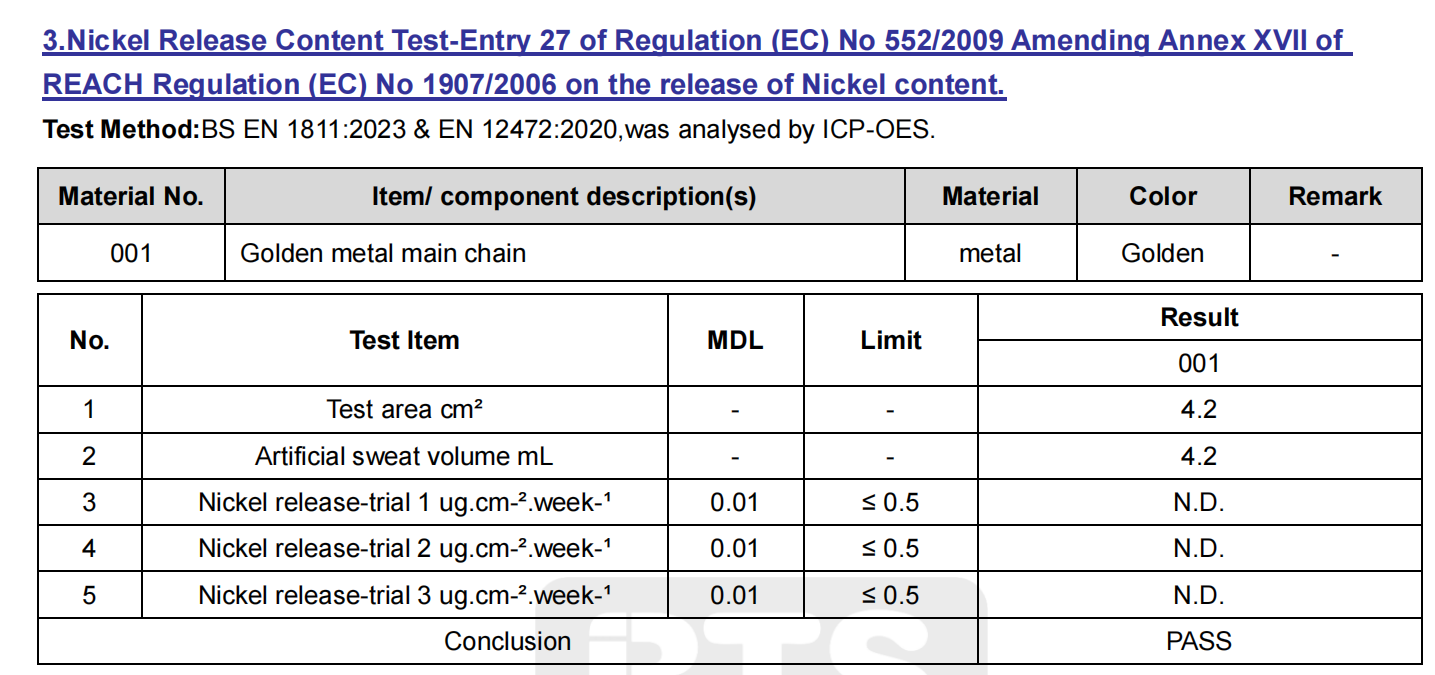
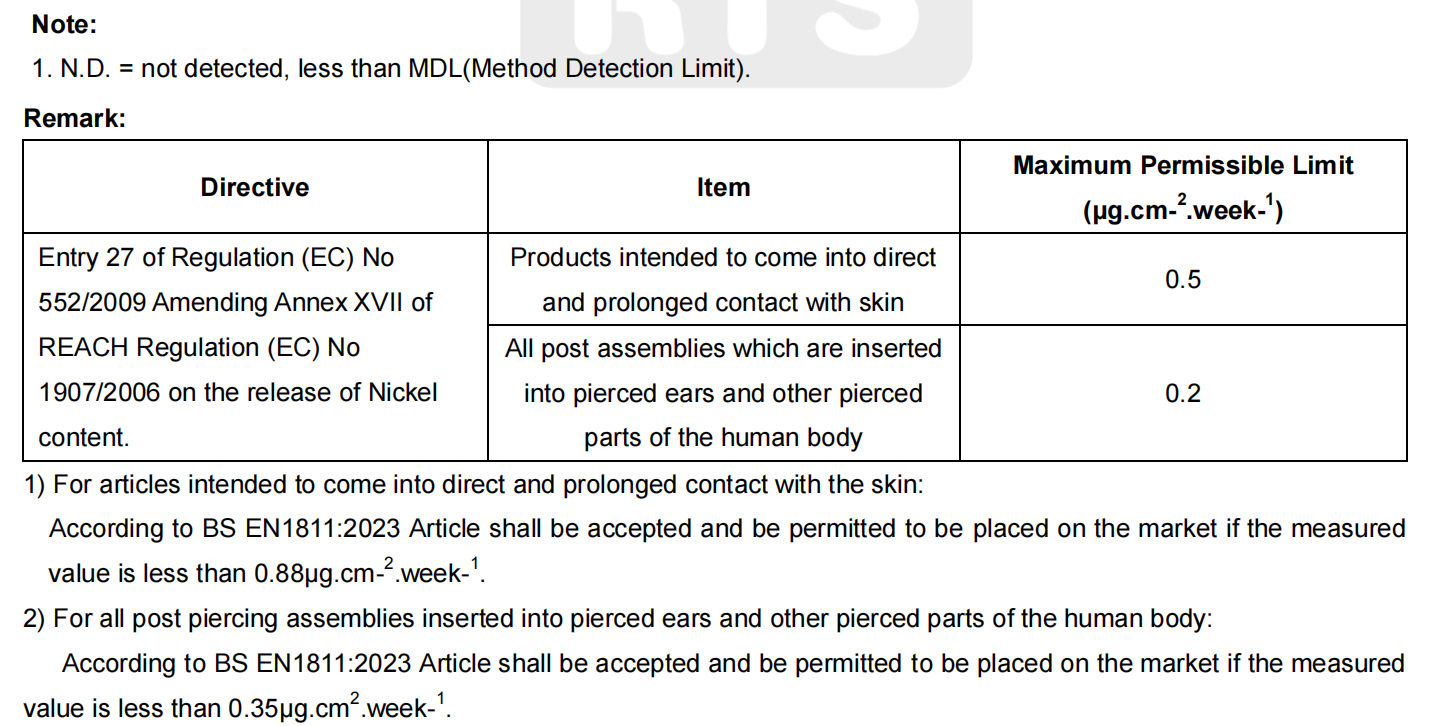
Scope: this result applies only to the sample, component and test conditions identified in the report. It does not certify every Jinming product or every buyer-specific RSL. Confirm the product, destination market and required test scope before production.
Does PVD coating reduce the risk?
A continuous, well-made PVD coating can act as an additional barrier between the steel and the wearer. A 2024 study using EN 1811 conditions found no nickel release from the PVD-coated 316L samples evaluated in that specific experiment, while also showing that surface preparation and coating construction can strongly affect release.
That result should not be converted into a blanket promise. Coverage, passivation, pores, scratches, wear and production consistency all matter. The finished product still needs to be evaluated against its intended use and market requirements.
Practical wording for product claims
Do not promise that a product can never cause a reaction. “Hypoallergenic” should be used carefully and supported by the material, coating process and relevant finished-product test results. More precise wording is often stronger: state the stainless steel grade, identify the coating, and say that the finished product was tested to the applicable nickel-release requirement when evidence is available.